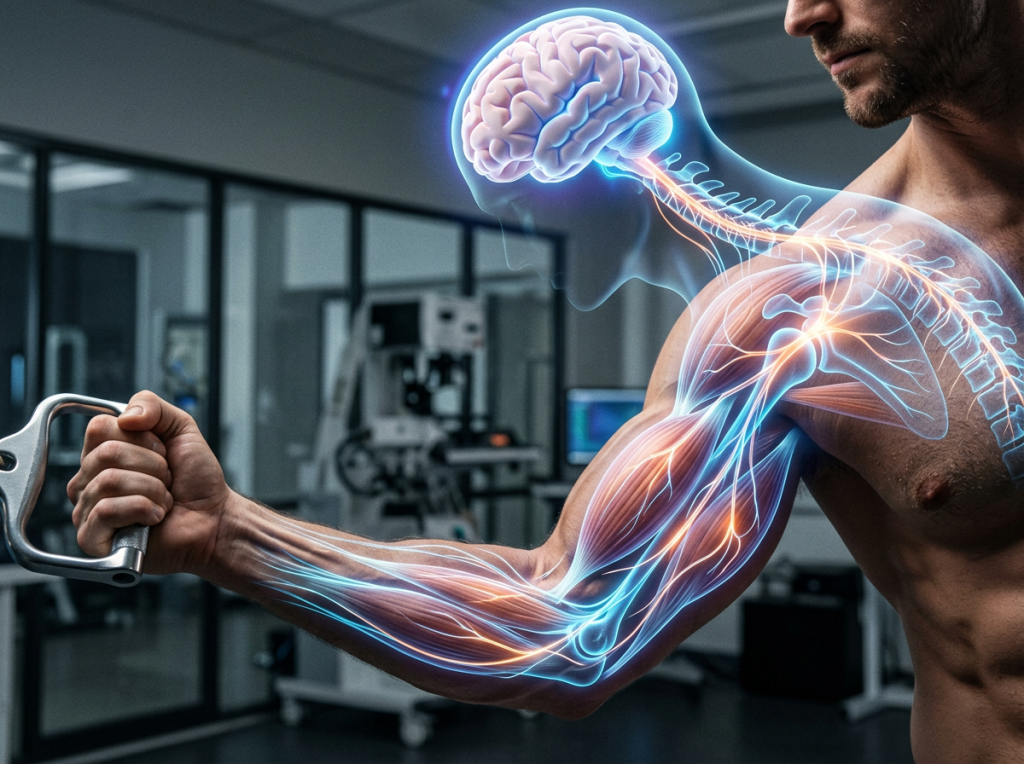


Ever wondered why some athletes get back to top form quickly after a break? Is muscle memory just a myth, or is it real? Knowing how muscle memory works can really change how you see training and rest.
Muscle memory is, in fact, a real thing, supported by science. It’s about how your body adapts in both your brain and your muscles. Even when you stop training, your body keeps the strength and skills you’ve gained. This means you can get back to your workouts faster.
This section will explore the amazing world of muscle memory. You’ll learn what happens to your muscles and strength when you take a break. You’ll also see the science behind keeping muscle strength and why it’s important for your fitness journey.

Key Takeaways
- Muscle memory is a scientifically supported phenomenon.
- It involves both neurological and cellular changes in the body.
- Strength and skills can be retained even after training breaks.
- Understanding muscle memory can enhance your training approach.
- Muscle memory allows for faster recovery when resuming workouts.
Understanding Muscle Memory: The Science Behind the Phenomenon
Muscle memory is a fascinating topic that involves both your brain and muscles. It explains how you can regain strength and skills after a break from training. There are two ways muscle memory works: through neurological adaptation and cellular mechanisms. Understanding these concepts helps you appreciate how your body retains the benefits of training.
The Two Types of Muscle Memory
Muscle memory can be categorized into two types:
- Neurological Memory: This refers to how your brain and nervous system adapt to movements. Your brain creates efficient pathways, allowing you to perform tasks with less conscious effort.
- Muscular Memory: This involves physical changes in your muscles. When you train, your muscle fibers grow and adapt, leading to muscle growth.
Neurological Adaptation and Its Role in Skill Retention
Neurological adaptation plays a crucial role in how you retain skills. As you practice, your brain strengthens connections between neurons. This process enhances your ability to perform movements smoothly. The result is a more efficient communication system between your brain and muscles.
Cellular Mechanisms: Myonuclei and Muscle Growth
Cellular mechanisms are equally important. When you engage in resistance training, your body recruits myonuclei from satellite cells. These additional nuclei support muscle growth and repair. Even when you take a break, these myonuclei tend to remain, making muscle memory a real phenomenon. This retention allows for quicker regrowth when you resume training.
| Aspect | Neurological Adaptation | Cellular Mechanisms |
|---|---|---|
| Definition | Brain’s ability to create efficient pathways | Recruitment of myonuclei from satellite cells |
| Impact on Performance | Improved skill retention and execution | Increased muscle size and strength |
| Duration of Effect | Short-term but can last with practice | Long-term retention of myonuclei |

How Muscle Cells Grow and Adapt During Training
When you train regularly, your muscle cells change a lot. It’s important to know how your body adapts and gets stronger. Satellite cells are key in this process, helping your muscles grow by adding extra nuclei for better function and repair.
The Role of Satellite Cells in Muscle Hypertrophy
Satellite cells are special muscle stem cells that kick in during training. They are crucial for muscle growth because:
- They give muscle fibers more nuclei.
- This helps with more protein making.
- More nuclei means muscles can grow and fix themselves better.
As muscles grow, they need more nuclei to handle increased protein synthesis. This shows how important nuclei are for muscle adaptation.
Why Muscles Gain Extra Nuclei and Their Importance
Muscle fibers are big and have many nuclei. One nucleus can’t do it all. Getting extra nuclei is important for several reasons:
- It helps muscles grow more during hypertrophy.
- It makes recovery from exercise damage easier.
- It helps with muscle memory, making it easier to regain strength after a break.
Knowing how these cells work helps us understand muscle memory. It’s not just a saying. It’s a real process based on biological changes from training.

Is muscle memory real? What happens when you stop training
Stopping your training routine can change your body in noticeable ways. Knowing these changes helps you get back into shape. You might wonder about muscle size and strength when you’re not training. Short breaks might not cause big muscle loss, but longer ones can.
Short-Term Effects of Training Breaks on Muscle Size and Strength
The first few weeks without training won’t drastically shrink your muscles. Here’s what happens:
- Minimal muscle loss in the first 2-3 weeks
- Gradual decrease in strength and endurance after 3-4 weeks
- Noticeable muscle loss after several weeks of inactivity
Scientific Evidence Supporting Myonuclear Permanence During Atrophy
Studies show myonuclear permanence is key to muscle memory. When you train, your muscles get extra myonuclei. These don’t disappear when you’re not active. So, even with muscle loss, you can grow back faster when you start training again. This muscle memory, a real phenomenon, lets you recover faster than starting over.

In short, knowing about the permanence of myonuclei can calm worries about muscle loss. You keep a cellular “memory” that helps you get back into shape. This makes your fitness journey smoother and more efficient.
The Neurological Side of Muscle Memory: Your Brain Remembers
Your brain is key to muscle memory. Regular training improves how well your brain communicates with your muscles. This makes movements smoother and more automatic over time.
For example, bench pressing gets easier and more controlled as you practice. This shows how your brain adapts to muscle training.
Regular training leads to neurological adaptation. This strengthens the brain-muscle connection. So, even after breaks, you can quickly regain skills and strength.
Improved Brain-Muscle Communication From Regular Training
Training improves how your brain and muscles work together. This better brain-muscle communication means:
- Enhanced coordination
- Faster reaction times
- Greater control over movements
Skill Acquisition and the Efficiency of Neural Pathways
Skill acquisition is a big part of training. Your brain makes efficient pathways for movements. This makes learning new skills faster and easier.
- Learn new skills faster
- Perform complex movements with ease
- Recover skills after breaks quickly

Understanding the neurological side of muscle memory highlights training’s value. The more you practice, the stronger these connections get. This makes it easier to reach your fitness goals.
Timeline of Muscle Loss When You Stop Training
Knowing when muscle loss happens is key for anyone taking a break from working out. You might not see changes right away. But over time, the effects of not training become more obvious. This section explains how muscle size and strength decrease over time. It will also talk about what affects muscle loss.
Changes Over Weeks and Months of Detraining
When you stop working out, your muscles start to weaken and shrink at different speeds. Here’s a general timeline of muscle loss:
| Time Frame | Muscle Loss Effects |
|---|---|
| 1 Week | No significant change |
| 2-4 Weeks | Slight muscle loss begins |
| 1-2 Months | More noticeable muscle and strength decline |
| 3+ Months | Significant muscle loss and strength reduction |
Factors Influencing the Rate of Muscle and Strength Loss
Several things can affect how fast you lose muscle:
- Age: Older people might lose muscle faster.
- Nutrition: A poor diet can accelerate muscle loss.
- Training History: Your past workout experience can influence recovery.
- Lifestyle Habits: Stress and sleep quality also matter.
Understanding these factors can help you know what to expect during breaks. Knowing about muscle memory can help you get back into training. It makes it easier to regain lost strength and size.

Modern Scientific Research: Debunking and Confirming Gym Folklore
Many gym-goers hear claims about muscle memory. Some are true, while others are gym folklore debunked. Modern science proves that muscle memory is real, backed by studies of the brain and cells.
Research proves muscle memory is not just a myth. It shows how our bodies keep muscle strength and size even when we stop training. Key points include:
- The concept of myonuclear permanence, which shows that muscle cells retain extra nuclei even when shrinking.
- Studies on animals consistently support the existence of muscle memory.
- Human studies are still ongoing, with some arguing about the permanence of myonuclei in humans.
Knowing the science of muscle memory boosts your workout confidence. It’s key to know which gym myths are true. For instance, science supports the idea that you can regain lost muscle faster with prior training. This helps you plan better workouts.
In short, modern science backs muscle memory as a real phenomenon. It shows that training adaptations last longer, helping you recover faster after a break. This knowledge can improve your fitness journey.
How Muscle Memory Supports a Faster Comeback After Time Off
When you stop training, you might wonder how fast you can get back to your old strength and size. Muscle memory is key in this process. Knowing how your body grows back after a break helps you understand why it’s so effective.
Why Muscle Regrowth Is Faster Due to Retained Myonuclei
Your muscles can quickly recover because of retained myonuclei. These extra nuclei help your muscles grow and develop. Even when you’re not training, your muscles keep these nuclei, making it easier to grow back when you start again. This is why your muscle memory comes back so quickly.
Neurological Efficiency Returning Quickly After Breaks
Your brain also plays a big part in this. The neural pathways you built up during training stay strong. This means you can quickly get back your strength and skills. It’s like your body and brain remember how to do things.
PowerBlock insights show how myonuclei retention and brain-muscle communication help with recovery. This teamwork between muscle cells and your nervous system helps you recover faster after a break.
| Factor | Impact on Comeback |
|---|---|
| Retained Myonuclei | Facilitates quicker muscle regrowth |
| Neurological Efficiency | Enhances skill and coordination recovery |
| Training Experience | Reduces time needed to regain strength |
In summary, the mix of retained myonuclei and improved neurological efficiency accelerates recovery. Knowing this can give you the confidence to start training again.
Strategies to Maximize Muscle Memory Benefits When Returning to Training
Getting back to training after a break can be tough. You want to safely regain your strength and size. Using the right strategies can help you return to your routine smoothly.
Starting Slow with Progressive Overload
Starting slow is a great comeback strategy. Progressive overload lets you gradually increase workout intensity. This approach prevents injuries and ensures steady progress. Here are some tips:
- Begin with lighter weights to assess your current strength.
- Increase the weight by small increments each week.
- Focus on maintaining good form to maximize muscle memory.
Importance of Relearning Proper Form and Technique
Relearning proper form is key when you return to training. If you’ve been away, your movement might not be as efficient. Good technique avoids bad habits and injuries. Consider these points:
- Use adjustable dumbbells for flexible workouts.
- Take time to practice each movement slowly.
- Consider working with a trainer for feedback on your form.
By following these strategies, you can safely regain your strength and size. Remember, patience is crucial. Stay consistent and gradually challenge yourself to improve muscle memory.
Impact of Lifestyle Factors on Muscle Retention and Memory
Your lifestyle greatly affects how well you keep muscle and use muscle memory. Eating well, staying hydrated, and getting enough sleep are key for muscle recovery and growth. By focusing on these, you help your body maintain gains and recover quickly when you resume training.
- Nutrition: Eating enough protein is crucial for muscle repair. Aim for a balanced, nutrient-rich diet to fuel your workouts.
- Rest: Sleep is when your body fixes itself. Quality sleep helps muscles recover and get stronger.
- Hydration: Staying hydrated is key for best performance and recovery. Dehydration can slow down muscle function.
- Stress Management: High stress can harm muscle retention. Use relaxation techniques to keep stress low.
- Rest Days: Rest days let muscles recover, preventing overtraining and injury.
By paying attention to these lifestyle factors, you can boost the lifestyle impact on muscle retention. This method not only helps muscle growth but also keeps strength over time. Remember, a complete approach to your fitness routine is essential for lasting success.
The Controversy and Debate Around Muscle Memory in Human Models
The debate on muscle memory is quite complex. Many studies look at how it works in animals. But applying these findings to humans is tricky. This is because animals and humans have different muscle structures and metabolism.
It’s important to understand these differences. This helps us better understand the science of muscle memory.
Animal Studies vs. Human Research Findings
Animal research has given us valuable insights into muscle memory. Key findings include:
- Myonuclear permanence during muscle atrophy is well-documented in animals.
- Animal studies often show rapid muscle recovery after periods of inactivity.
- Differences in muscle architecture may affect how these findings apply to humans.
Challenges in Measuring Myonuclear Retention in Humans
Measuring myonuclear retention in humans is challenging:
- Variability in human muscle composition complicates research.
- Technical limitations make it difficult to accurately assess myonuclear domains.
- Long-term studies are needed to fully understand retention and loss.
These challenges show we need more research focused on humans. By understanding the differences between animal and human studies, we can advance the science of muscle memory. As research continues, we’ll gain clearer insights into human muscle memory.
Conclusion
Muscle memory is real, and science proves it. Even when you stop training, your brain and muscles remember. This means you’ll recover and grow faster when you start again.
Knowing how your body remembers can help you. It shows you can trust your body’s memory. This knowledge is powerful.
When you start again, you’re not starting over. You’re using the strength and skills you’ve built. With patience and smart plans, you’ll get back in shape quickly.
So, trust your body’s memory. Be confident in your journey back to training. Stay informed and keep pushing towards your fitness goals.







Leave a Reply