

Why do some people move with grace and confidence while others struggle with simple tasks? The answer often involves balance, a key skill that supports steady movement. As we age, keeping our balance becomes more important, but it is not a fixed trait.
The truth is, balance is a trainable skill, not a fixed trait. Anyone can improve it at any age or fitness level. It takes minutes a day and no equipment to train your balance.
Research shows that good balance helps people live active and independent lives. The right exercises and mindset can help you recover from injury or stay steady for years. Balance work can also lower the risk of falls and improve mobility.

This guide, How to build better balance at any age, shares simple ways to improve stability. These steps can support a healthier, more confident life.
Key Takeaways
- Balance is a skill that can be improved with practice.
- Regular exercise enhances stability and reduces fall risk.
- Improving balance takes only minutes a day.
- No special equipment is needed for balance training.
- Staying active contributes to overall health and independence.
Why balance matters at every age
Understanding why balance matters can improve your quality of life at any age. Balance supports nearly every movement, including walking, bending, reaching, and exercising.
When balance declines, simple tasks can feel difficult, and you may avoid activities you once enjoyed. You may struggle to carry groceries, use stairs, or step off a curb. Falls are one of the leading causes of injury, especially among older adults, but the right approach can prevent them.
The hidden cost of poor balance in daily life
Many people underestimate the hidden costs of poor balance. It can slowly weaken confidence and mobility, reducing your quality of life.
Poor balance greatly raises fall risk, and injuries may have lasting effects. Recovery can take a long time, limiting your activities and independence.
Balance is a trainable skill, not a fixed trait.
Many people wrongly think balance is fixed at birth and must decline with age. In reality, balance is a trainable skill, not a fixed trait, much like strength or endurance. Focused practice and stability exercises can improve it at any age.
Daily life uses your muscles, but it cannot fully prevent age-related decline. To maintain balance, actively practice exercises that challenge your stability. This approach helps you stay upright and supports your long-term independence.

What the 10-second balance test reveals
The 10-second balance test checks your stability. What is the 10-second test? It quickly assesses your balance and highlights areas for improvement. This guide explains how to do it at home and understand your score.
How to perform the test at home
The 10-second balance test is simple and needs no special equipment. Follow these steps:
- Stand on one foot.
- Keep your arms at your sides or crossed over your chest.
- Time yourself to see how long you can maintain this position without touching down or grabbing support.
Choose a safe space at home, such as your living room or kitchen. Keep support nearby if needed, and remember that the test helps you learn about your balance, not just your score.
What your score actually means
When you take the 10-second balance test, aim for at least 10 seconds, a common sign of good balance. If you have taken the 10-second test and did not like the result, this is the training plan. It takes minutes a day and no equipment to start improving your balance.
“Good balance is a marker for longevity.”
Use your score as motivation. A lower score is not a reason to panic; it is an opportunity to build greater stability. Balance is a trainable skill!

How your balance system actually works
Understanding your balance system is crucial for effective training. The one thing to understand first: balance is your brain blending three inputs—your inner ear, your vision, and proprioception. Together, these inputs help you stay stable and coordinated.
Your inner ear contains the vestibular system, which detects head position and movement. It sends signals to your brain about your body’s orientation in space. Your vision provides a reference, while proprioception senses your body’s position through muscles, joints, and tendons, keeping you upright and balanced.

The three inputs your brain blends together.
Your brain continuously processes these three inputs to maintain balance. That last one matters most because your brain blends these inputs to maintain balance. When you stand, walk, or do any physical activity, your brain receives head-movement data, visual cues, and proprioceptive feedback.
This blending helps you stay stable, especially on uneven surfaces or during sudden movements.
Why proprioception is the one you can train hardest
Proprioception matters most, and it is the one you can train hardest. Your inner ear and vision adapt less readily, but exercises can improve proprioception and your body’s awareness of its position. Practice that challenges this awareness can enhance your balance.
Every progression in balance training works by making one of these three inputs harder to rely on. For instance, standing on one leg reduces visual input, forcing the other inputs to compensate. This is the core method: challenge your body in different ways to strengthen adaptation.
With this understanding, you can approach balance training with intention. Instead of merely following instructions, you’ll see how each drill supports your overall stability and coordination.
The three foundational drills to start with
Improving balance may be easier than you think. These three foundational drills fit into your daily routine. They build stability and coordination for everyone.
Single-leg stand
How to do it
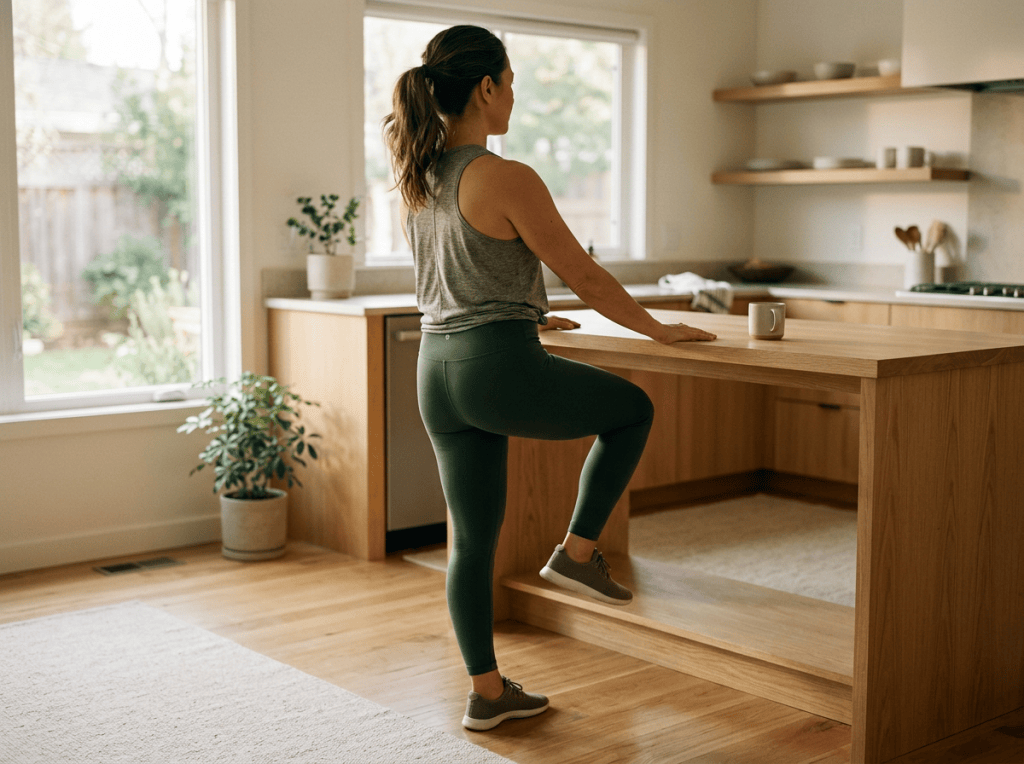
To do the single-leg stand, stand tall, engage your core, and look forward. Lift one foot a few inches off the floor, stand on one foot, and hold for 10-30 seconds. Repeat on each leg to improve balance.
Where to fit it in
You can do it anywhere, including while brushing your teeth or waiting for your coffee to brew. It adds balance practice to daily activities.
Heel-to-toe walking
How to do it
For heel-to-toe walking, walk a straight line as though on a tightrope, with the heel touching the toe each step. Move slowly and extend your arms to challenge stability.
Where to fit it in
Try this exercise in a hallway or any clear stretch of floor. It builds balance while moving and fits easily into daily walks.
Weight shifts
How to do it
To do weight shifts, prepare for controlled movement. At a counter, move deliberately side to side and front to back, controlling the transfer rather than falling into it. This builds proprioception and balance control.
Where to fit it in
Practice while cooking or waiting for your coffee. Use the kitchen counter for support. For safety, do all three near a counter or wall you can grab.
“Simple activities, like standing on one foot while brushing your teeth or practicing heel-to-toe walking down the hallway, make a difference.”

How to build better balance at any age: the progression ladder
This is where most people stall, because they do the same drill at the same difficulty forever. They wonder why nothing improves. Progressive overload applies to balance exactly as it does to lift; work up this ladder, one step at a time.
Why progressive overload applies to balance too
Balance exercises must grow harder over time. As with weightlifting, an easy drill means it is time to increase the difficulty and keep training engaging.
Step 1: Two fingers on the counter
Start with two fingers on the counter instead of a full hand. This reduces support while keeping a safety net, building confidence as you shift your weight and find your center of gravity.
Step 2: No hands, support nearby
After step one feels comfortable, try balancing with no hands. Keep support nearby, such as a wall or counter, as you build confidence without fully letting go.
Step 3: Eyes closed
Next, balance with your eyes closed. This removes visual dominance and forces proprioception to work. It makes balance harder because your brain cannot rely on visual input.
Step 4: Unstable surface
Stand on an unstable surface, such as a cushion or a folded towel. This challenges your proprioceptive system because the ground feels less predictable, forcing your body to adapt and strengthen.
Step 5: Head turns
Add head turns that directly challenge the vestibular system. This makes stability harder and forces your inner ear to work harder, improving overall balance.
Step 6: Add movement
Finally, add movement, reaching, passing an object between hands, or a slow squat. These drills combine balance with movement and simulate real-world situations, making training more practical.

Why leg strength is half the equation
Leg strength plays a key role in balance, especially as we age, which is why it is half of it. Good proprioception and vestibular function matter, but they cannot overcome weak legs; that is why Balance without leg strength is fragile.
Catching yourself after a stumble is not a balance skill; it is a power skill requiring force produced fast. Weak leg muscles may make it hard to recover your balance. Strong muscles stabilize you, control movement, and help you adjust to changes around you.

To improve balance, add simple strength moves to your routine. Squats, bridges, heel raises, and step-ups build the leg and core strength needed for stability. You do not need heavy weights; bodyweight moves or resistance bands can work too.
Experts recommend strength training at least twice a week. Work your upper body, core, and lower body. All these areas must support daily tasks, such as carrying groceries or navigating stairs, as you age.
Pair balance drills with basic strength work to build a more resilient, fall-resistant body. Balance and strength work together, so prioritize both in your training.
How to fit balance training into your daily routine
Balance training is simple to add to daily life. You do not need a gym or a dedicated session to improve your balance. To learn how to fit it in, stack it as a habit onto what you already do.
Habit stacking: pairing drills with what you already do
Use familiar activities for balance drills. The examples below show simple ways to fit them into your routine.
- Single-leg stand while brushing your teeth.
- Heel raises while waiting for the kettle to boil.
- Weight shifts at the kitchen counter during meal prep.
A few minutes, several times a week, meaningfully improve your balance.
Why consistency beats intensity here
For balance training, consistency beats intensity here more than almost anywhere else in fitness. Unlike traditional workouts, balance training does not require one heavy session now and then. Regular, moderate challenges help rewire your nervous system.
If you are sedentary, it’s important to start low and go slow. This matters especially for older adults. Gradually increasing the amount of exercise builds strength and stability over time.
The best balance program is the one you actually do. Weaving these drills into daily activities creates a lasting path to improvement.

The wobble rule and other training principles
Understanding the wobble rule can improve your balance training. Remember, wobbling is your nervous system learning, not failing. Your body’s small corrections during a wobble strengthen balance more than a perfectly still hold.
Why wobbling means the drill is working
If you never wobble, the drill is too easy. That is the single most useful cue in balance training: welcome small corrections as you improve. Experts explain, “These skills in the muscles and brain improve when you regularly challenge your balance.”
Train both sides, not just your stronger leg
Do not favor your dominant leg during balance drills. Train both sides, not just your stronger leg, and build equal strength for real-world stability. A fall or stumble can happen on either side, so balanced legs prepare you for unexpected challenges.
Progress gradually and train year-round
Progress gradually with support nearby. Regular practice builds confidence and improves your skills over time. Stay safe, avoid pushing too hard too soon, and do it year-round rather than only after a scare.
Embrace the wobble, train both sides, progress slowly, and never stop practicing. Together, these simple principles can help you maintain and improve your balance, confidence, and agility throughout your life.
Conclusion
Building better balance at any age starts with a journey that can improve your life. It supports independence and confidence, making daily activities easier and safer. Balance is not fixed; you can train it, and the 10-second balance test is only the beginning.
Understanding your balance system is essential. Your brain uses three inputs, and you can train them, especially proprioception. Mastering foundational drills, including single-leg stands, heel-to-toe walking, and weight shifts, builds a strong foundation. The balance ladder develops resilience and adaptability.
Leg strength plays a vital role in balance. Simple strength exercises support your balance training, while habit stacking fits drills into daily life. Consistency works better than intensity for balance training.
Embrace the wobble rule because wobbling shows that you are challenging your balance. Train both sides of your body for a well-rounded approach. Balance training is a year-round commitment that helps maintain your health as you age.
You do not need a gym or special equipment to begin. A few minutes daily, a wall or counter for support, and willingness to wobble can make a big difference. Begin today, and you can become steadier, more confident, and more independent, no matter your age.


 trim down and shape up
Leave a comment